
When we discuss climate change, conversations usually focus on energy, emissions, and efficiency. Yet one key driver remains largely overlooked: consumption. According to the “Advertised Emissions Germany” report recently published by Novatopia, advertising plays a crucial role in shaping consumption patterns — and consequently, emissions.
It’s not just how we advertise but what we advertise.
Advertising today is responsible for roughly 5% of Germany’s national carbon footprint, nearly half the impact of the entire agricultural sector. Each euro invested in advertising generates approximately 200 grams of CO2eq through additional consumption, amplifying environmental impacts significantly.
But here’s the silver lining: advertising can also drive meaningful change. Megan Thudium, Managing Director at Content for Good & Co., emphasizes:
By strategically redirecting advertising towards sustainable products and practices, agencies can substantially lower their climate footprint.
The report highlights two distinct emissions categories within advertising: infrastructural emissions (resulting directly from producing and distributing ads) and advertised emissions (generated by increased demand through advertising). Advertised emissions are approximately ten times higher than infrastructural emissions, underscoring the potential impact of intentional, conscious advertising.
Advertisers have the unique power (and responsibility) to shape consumer behavior, thereby driving a transition towards a sustainable economy.
Current advertising largely promotes emissions-intensive products like vehicles and meat-based foods, each significantly exceeding the German average of 200g CO2eq per euro spent. Yet, alternatives like electric vehicles or plant-based foods demonstrate far lower emissions per euro, indicating a clear pathway for responsible advertising.
To leverage advertising as a tool for climate action, the report proposes clear, actionable steps:
- Reducing the promotion of high-emission products,
- Developing brands with transformative potential,
- And actively scaling low-emission and regenerative products.
Additionally, improving transparency through standardized tools and KPIs is vital, enabling agencies to measure and manage their true climate impact effectively.
When advertisers embrace these strategies, they fulfill ethical responsibilities and safeguard their market relevance. According to BCG and the University of Cambridge, climate-positive investments yield a return up to 14 times the initial input, while unchecked climate change could cost Germany €900 billion by 2050.
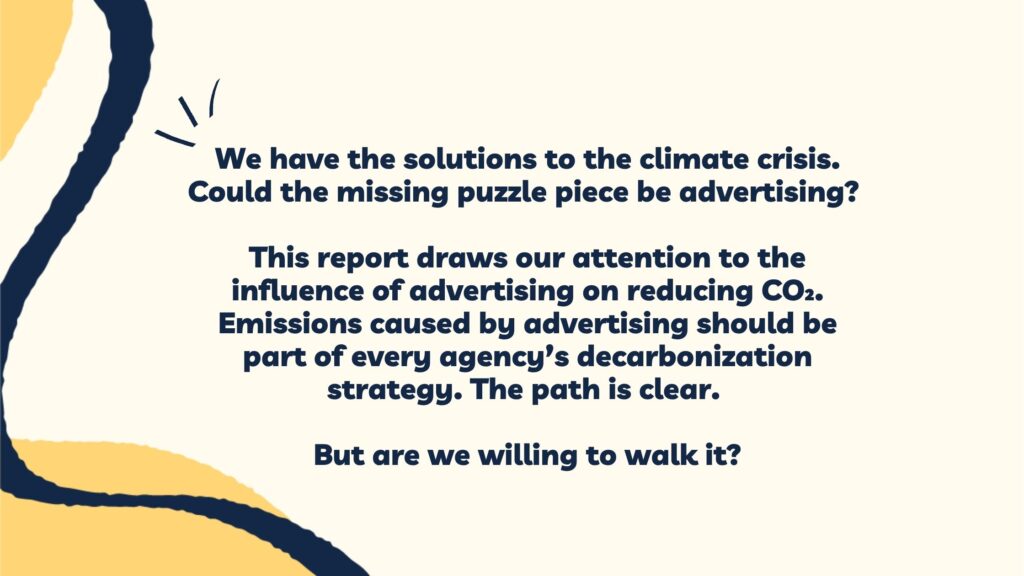
The path is clear. The stakes are high. Now is the time for the advertising industry to use its influence as a force for good.
Want to dive deeper into how your agency can become a climate action leader? Read the full Advertised Emissions Germany report and join us at Content for Good & Co. in shaping our industry into a force for good!