
If greenwashing is the loud neighbour bragging about their eco-friendly lifestyle while secretly tossing recyclables in the trash, then greenhushing is the one who refuses to talk about sustainability at all.
Both behaviours raise eyebrows, but for different reasons.
In recent years, greenhushing has emerged as a growing trend. Companies that once rushed to showcase their climate targets and net-zero promises are now pulling back, choosing silence over disclosure.
Why? For some, greenhushing is a defensive tactic. Choosing silence because regulation and public scrutiny are catching up with them, and they fear public backlash or accusations of greenwashing. For others, it’s less about intent and more about insecurity.
Communications teams are hesitant to publish updates because they’re unsure if their claims are accurate or fearful of being called out. This lack of confidence often stems from unclear rules, inconsistent standards, and limited training on what “good” sustainability communication looks like. The danger is that even brands doing meaningful work may retreat into silence. The result is a communications vacuum that leaves investors, regulators, and consumers wondering if progress is truly being made, or if climate commitments are quietly stalling.
Dig into this article to learn:
- How the greenhushing vs greenwashing discussion is reshaping sustainability communication,
- Why businesses are increasingly going quiet about their green goals and whether that’s riskier than overclaiming, and
- What frameworks and practices can encourage transparency and accountability without punishing ambition?
What is greenhushing?
Greenhushing refers to organisations’ intentional decision not to publicize their environmental or social targets (or their plans to reach them) to avoid scrutiny and allegations of greenwashing. This radio silence approach may stem from fear of criticism, regulatory backlash, or reputational risk.
Recent data underscores the prevalence of this behavior.
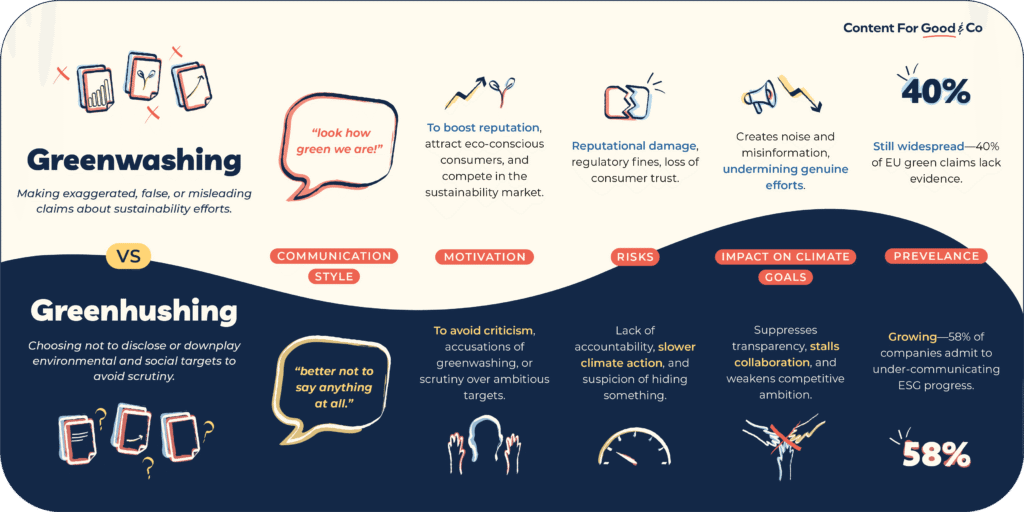
In a global survey by South Pole, 58% of companies admitted to under-promoting their ESG actions and factual data despite having made sustainability commitments, effectively greenhushing potential strengths instead of sharing them publicly.
Define greenwashing
Greenwashing misleads stakeholders by presenting false sustainability claims about a brand’s products, initiatives, or services. It skews perception and influences decisions under false pretences.
While some brands may deliberately leverage these claims, others may do so out of ignorance or inadequate internal validity checks.
Greenwashing vs greenhushing
If greenwashing is shouting too loudly about sustainability without backing it up, greenhushing is the decision to stay silent even when there’s progress to share.
Both approaches distort the picture: one oversells, the other undersells.
In the middle, consumers and regulators are left without the transparency needed to measure real impact.
Here’s how the two compare:
Why are brands choosing to greenhush?
A survey by EY and ESG Today shows that businesses often turn to greenhushing because:
- They fear criticism or reputational damage if they don’t meet bold targets,
- They lack confidence in hitting their sustainability goals on time, and
- They are unsure when, how, or through which channels to communicate sustainability progress.
What are examples of greenhushing?
Greenhushing doesn’t always look like silence. It often hides in how companies frame or report their climate efforts. Common tactics include:
- Vague or ambiguous language: Companies announce sustainability goals but use broad, undefined terms that make it nearly impossible for stakeholders to measure progress. This is where greenhushing becomes murky—some people would simply call it greenwashing.
- Pushing targets far into the future: Instead of detailing immediate steps, organizations frame climate action as long-term aspirations, effectively delaying accountability.
- Selective disclosure: Minor initiatives, like reducing office paper use, get the spotlight, while major environmental challenges, such as supply chain emissions, remain buried. This could also be called greenlighting: the selective disclosure of a good action that, however, lacks context and meaningful impact.
This “look over here, not there” tactic maintains a positive image while avoiding scrutiny of bigger issues. Genuinely sustainable companies risk being drowned out by competitors who share less, while consumers and investors are left without the full picture.
And it’s worth noting that greenhushing rarely exists in isolation. In practice, it often overlaps with or blurs into other forms of greenwashing, making the landscape of sustainability communication even more complex.
Is it that bad, really?
Movements depend on visibility: without it, pressure dissipates, and progress stalls.
Greenhushing impedes systemic change by reducing the competitive pressure that comes from open disclosure. If businesses don’t talk about their climate targets, they remove the benchmarks and peer comparison that push entire industries toward faster, bolder action.
“In a time of greenhushing, when many companies hesitate to share their sustainability efforts for fear of criticism, it’s more important than ever to highlight real progress,” says Robert Gerlach, CEO at Klim. “Verified achievements, like Nestlé reaching its regenerative agriculture targets ahead of schedule, deserve recognition.”
That recognition, in turn, motivates other companies to join the sustainability cause.
Is greenhushing really happening? Isn’t it just better communication?
Here’s where the debate gets interesting.
While surveys show many companies admit to under-promoting their ESG goals, some experts suggest this may not be greenhushing at all, but instead a shift toward smarter communication.
- NewClimate Institute reviewed climate reporting from more than 70 companies and found no evidence of widespread backsliding. Instead, they observed a move away from highly ambiguous claims like “carbon neutrality” and toward more transparent, nuanced reporting (NewClimate).
- This shift could be a positive outcome of tighter regulations and voluntary standards, which are nudging companies toward evidence-based communication rather than flashy slogans.
- Some researchers argue that what we’re seeing is neither greenwashing nor greenhushing, but rather the early signs of maturing climate communication, where exaggerated claims are replaced with more measured, factual disclosures.
At the same time, consumer skepticism is rising.
A 2020 study in Environmental Sciences Europe found that as greenwashing incidents grew, so did green skepticism, making it harder for even genuine green claims to be trusted. In this context, some companies may choose silence as a survival instinct in an increasingly critical market.
Silence isn’t golden when it comes to climate action
So, what have we learned from digging into greenhushing?
- Greenhushing vs greenwashing is a false choice. Whether companies over-claim or under-communicate, both erode trust and hinder real progress.
- Silence slows momentum. By not talking about sustainability goals, businesses remove the benchmarks and peer pressure that drive industries forward.
- Transparency builds accountability. Open disclosure, even with imperfect progress, creates healthier competition and accelerates climate action.
Want to stay ahead of regulations, avoid reputational risks, and communicate with authenticity?
At Content For Good & Co., we believe better communication leads to better climate and social outcomes. That’s why we help marketers and communicators build confidence in sharing sustainability efforts without slipping into greenwashing or falling into the trap of greenhushing.
Contact us to learn about our How *Not* To Greenwash workshops, designed to help your organisation navigate the fine line between silence and exaggeration with clarity and confidence.